If you’ve ever stood in a sweltering parking lot with your car’s AC blasting, or braved a frosty morning where your defroster cuts through fog before you even turn the wheel, you’ve got one unsung hero to thank: the automotive compressor. As someone who’s spent the last 12 years supplying these parts to garages, dealerships, and fleet operators across North America, I’ve talked to hundreds of customers who know their compressors matter—they just don’t always know exactly why. Most of the questions I get aren’t just about parts; they’re about the quiet, moving workhorse that makes in-car climate control feel like second nature. Let’s break it down, plain and simple, no jargon that makes your eyes glaze over. Automotive Compressor

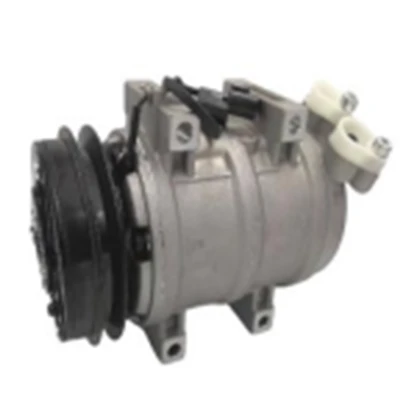
First, let’s start with the basics: what even is an automotive compressor, and why does it exist? If your car’s AC system were a team, the compressor would be the quarterback. But not the kind that throws fancy passes—this quarterback handles the refrigerant, the special fluid that carries heat from inside your car to outside. Refrigerant doesn’t just hang out in your AC lines; it changes state, moving between gas and liquid, and that phase change is where all the heating and cooling happens. The compressor’s only job is to control that refrigerant, pushing it through the system so it can do its job.
To understand how it works, we have to talk about pressure and temperature, because those two are inseparable when it comes to refrigerant. If you’ve ever noticed that a can of compressed air gets cold when you spray it, or that a balloon gets smaller when you squeeze it tight, you’ve experienced the same physics a compressor uses. When you squeeze a gas (like refrigerant) into a smaller space, you increase its pressure—and that pressure makes the gas heat up. When you let it expand, pressure drops, and it gets cold. That’s the core of how this whole system works.
Now, let’s walk through the step-by-step process, because it’s not as complicated as it sounds, and it all starts right in the compressor. Every compressor is mounted to your car’s engine (or, in electric cars, to the high-voltage battery system) with a belt or an electric motor turning its internal parts. Inside the compressor, there’s a set of chambers and valves that move refrigerant. Let’s follow the path:
-
The first stop for refrigerant is the compressor’s low-pressure inlet line. This is where the refrigerant comes from the evaporator, which is like a radiator inside your dashboard. When the refrigerant was in the evaporator, it was a low-pressure gas that absorbed heat from the air blowing into your car, turning cold in the process. Now, that warm, low-pressure gas is heading straight to the compressor.
-
Next, the compressor’s internal mechanism (most often a piston, scroll, or vane setup, depending on the car) squeezes that gas. Let’s take a piston compressor first, since it’s the most common for older gas-powered vehicles: think of a tiny, sealed cylinder where a piston moves up and down. When the piston pulls down, it creates a vacuum that pulls the low-pressure refrigerant gas into the cylinder through an inlet valve. When the piston pushes back up, it closes the inlet valve, compressing the gas into a much smaller space. That compression raises the pressure of the refrigerant from around 30 PSI to 200 PSI, and as we talked about earlier, compressing the gas makes it super hot—now it’s not just a low-pressure gas, it’s a high-pressure, high-temperature gas, often over 200 degrees Fahrenheit.
-
Then, that hot, high-pressure gas gets pushed out through the compressor’s outlet line, heading to the next part of the system: the condenser. The condenser is mounted in front of your car’s radiator, and it works like a tiny radiator for refrigerant. As the hot gas flows through the condenser’s thin fins, outside air blows over those fins (even when you’re not on the highway, the AC system has a fan), pulling the heat out of the refrigerant. As the refrigerant loses heat, it condenses into a high-pressure liquid—still under all that pressure, but now it’s a liquid instead of a hot gas.
-
From the condenser, the liquid refrigerant moves to the expansion valve, which is a tiny, precise part that acts like a nozzle. It meters out the liquid refrigerant into the evaporator at a much lower pressure. When the refrigerant hits that low pressure, it instantly expands, boiling into a cool gas. That boiling process absorbs a ton of heat from the air around the evaporator, which is exactly why the air blowing into your car is cold. The cycle then repeats: the cool, low-pressure gas heads back to the compressor, and we start all over again.
Wait a second—what about when you use the heat, not the AC? Good question, because the same compressor system works for heating, too, especially in newer cars with heat pump AC systems. Instead of pushing heat out of the car, it reverses the process: the compressor pushes refrigerant through a different set of lines, so it absorbs heat from outside air (even cold air, because refrigerant can pull heat from things below freezing) and dumps that heat inside the car. For electric vehicles, this is a game-changer because it’s way more efficient than old resistive heating, which drains the battery fast. That’s why so many EV manufacturers switched to heat pump systems over the last 5 years—and their compressors have to be even more precise, since they’re working with variable battery power instead of a consistent gas engine belt.
Now, not all automotive compressors are the same, and that’s where a supplier like me comes in. For decades, most compressors were piston-type, the simple up-and-down cylinder design I mentioned earlier. They’re reliable, affordable, and great for heavy-duty use in pickup trucks or work vans. But starting in the 2000s, scroll compressors took over for most passenger cars. Scroll compressors use two spiral-shaped metal pieces—one fixed, one rotating—to trap and compress refrigerant, instead of pistons. They’re lighter, quieter, and more efficient, which is why car manufacturers started using them to meet fuel economy standards. For electric cars, we also use electric variable-displacement compressors, which don’t connect to the engine belt at all. They run on their own electric motor, and can adjust how much refrigerant they pump depending on how hot or cold you want the car. That means they use less power, which is critical for electric range.
I’ve seen firsthand how important it is to get the right compressor for the job. A few years back, I worked with a fleet company that had 50 delivery vans with old piston compressors. They were breaking every 18 months, and the repair costs were eating into their profits. We switched them to variable-displacement scroll compressors, and not only did the failure rate drop to less than 2% a year, their fuel efficiency improved by 7% because the compressors didn’t drain extra engine power when they didn’t need to. That’s the kind of result that makes our job worth it: matching the right compressor design to the vehicle, the use case, and the owner’s needs.
But it’s not just about the design—it’s about the quality of the parts inside the compressor. A compressor is a sealed unit, right? All those moving parts are inside a metal shell, so if one bearing wears out or a valve fails, the whole thing stops working. That’s why I don’t cut corners on manufacturing. Every compressor we supply goes through 12 different tests before it leaves our warehouse: we check for leaks with pressurized nitrogen, run it on a test bench to make sure it’s pumping the right amount of refrigerant at the right pressure, and simulate thousands of miles of use to make sure it can handle extreme heat (we’ve tested them in 120-degree desert conditions) and freezing cold (down to 20 degrees below zero). I’ve had customers come to me after a bad experience with cheap compressors that failed in 6 months, and they tell me our parts last 5 or 6 years, even in the harshest climates. That’s the standard I stand by.
Common questions I get from customers usually revolve around maintenance and replacement. How do I know if my compressor is going bad? The signs are hard to miss: your AC blows warm air, there’s a squealing noise when you turn on the AC, or there’s a leak of refrigerant under the car near the firewall. If you ignore those signs, you can end up with a broken compressor that damages other parts of the AC system, like the condenser or evaporator, which costs way more to fix. Another question: do I need to replace the whole compressor if it fails? For most modern compressors, yes, because they’re sealed units with integrated valves and bearings that can’t be serviced without specialized tools. But that’s also why we make our compressors easy to install, with pre-mounted brackets and direct fit for most common car models, so garages don’t have to spend extra time modifying parts.
What about the future of automotive compressors? With electric vehicles becoming more common, the demand for compressors is changing fast. Electric cars need compressors that are small, lightweight, and energy-efficient, because every bit of power used for climate control eats into range. We’re already working on next-generation compressors that use less power, even at variable speeds, and can integrate with the car’s battery management system to adjust performance in real time. The old belt-driven compressors are going away for most EVs, and even many hybrid models are switching to electric compressors. That’s a good thing for drivers, because it means more consistent climate control, better fuel efficiency for hybrids, and longer range for EVs.
At the end of the day, the automotive compressor is one of those parts you don’t think about until it fails. It doesn’t have the flash of a infotainment screen or the power of an engine, but it makes every drive more comfortable, no matter the weather. For me, being a compressor supplier isn’t just about selling parts—it’s about making sure that when a driver turns their AC on in 90-degree heat, cold air comes out, and when they need their defroster to clear a foggy windshield on a winter morning, it works fast. I’ve built this business on listening to my customers, understanding their needs, and supplying parts that last.
If you’re a fleet manager, a repair shop owner, or someone looking to replace a failing compressor for your personal vehicle, I’m here to help. Whether you need a standard piston compressor for a work truck, a scroll compressor for a sedan, or a variable-displacement compressor for an electric vehicle, we have the right parts for your needs and budget. We work with garages across the country, offer bulk pricing for fleet accounts, and provide technical support to make sure the install goes smoothly. Reach out to our team to discuss your requirements, get a quote, or learn more about how we can support your operations.
Construction Compressor References
- Automotive Air Conditioning System Fundamentals, U.S. Department of Energy Office of Energy Efficiency & Renewable Energy
- Scroll vs. Piston Compressors: Efficiency and Application in Modern Vehicles, Society of Automotive Engineers (SAE International)
- Electric Vehicle Heat Pump System Design, International Council on Clean Transportation (ICCT)
- Automotive Compressor Performance Testing Standards, Automotive Service Excellence (ASE) International
Jiangsu Nuoyan New Energy Vehicle Air Conditioning Co., Ltd.
With abundant experience, we are one of the most professional automotive compressor manufacturers and suppliers in China. We warmly welcome you to buy customized automotive compressor at competitive price from our factory. Also, quotation is available.
Address: No. 7 Xingyuan Road, Huangqiao Economic Development Zone, Taixing City, Jiangsu
E-mail: nuyantech2026@163.com
WebSite: https://www.nuyantech.com/
